Line Integral Fluids

Indian Institute of Technology Delhi

Abstract

We introduce a new advection scheme for grid-based fluid simulation inspired by the recent covector fluids approach of Nabizadeh et al. 2022. We directly discretize the integral form of the covector transport equation, which ensures the conservation of line integral over any curve in the discretized fluid domain. Despite a theoretical argument for unconditional stability in 2D, we observe that numerical error in backtracing results in limited stability in practice. To address this issue, we further propose a stabilization heuristic based on the relative change in area of backtraced grid cells. We extend the heuristic to volume ratios in 3D and show that the proposed method is stable even at larger timesteps.

Method Overview

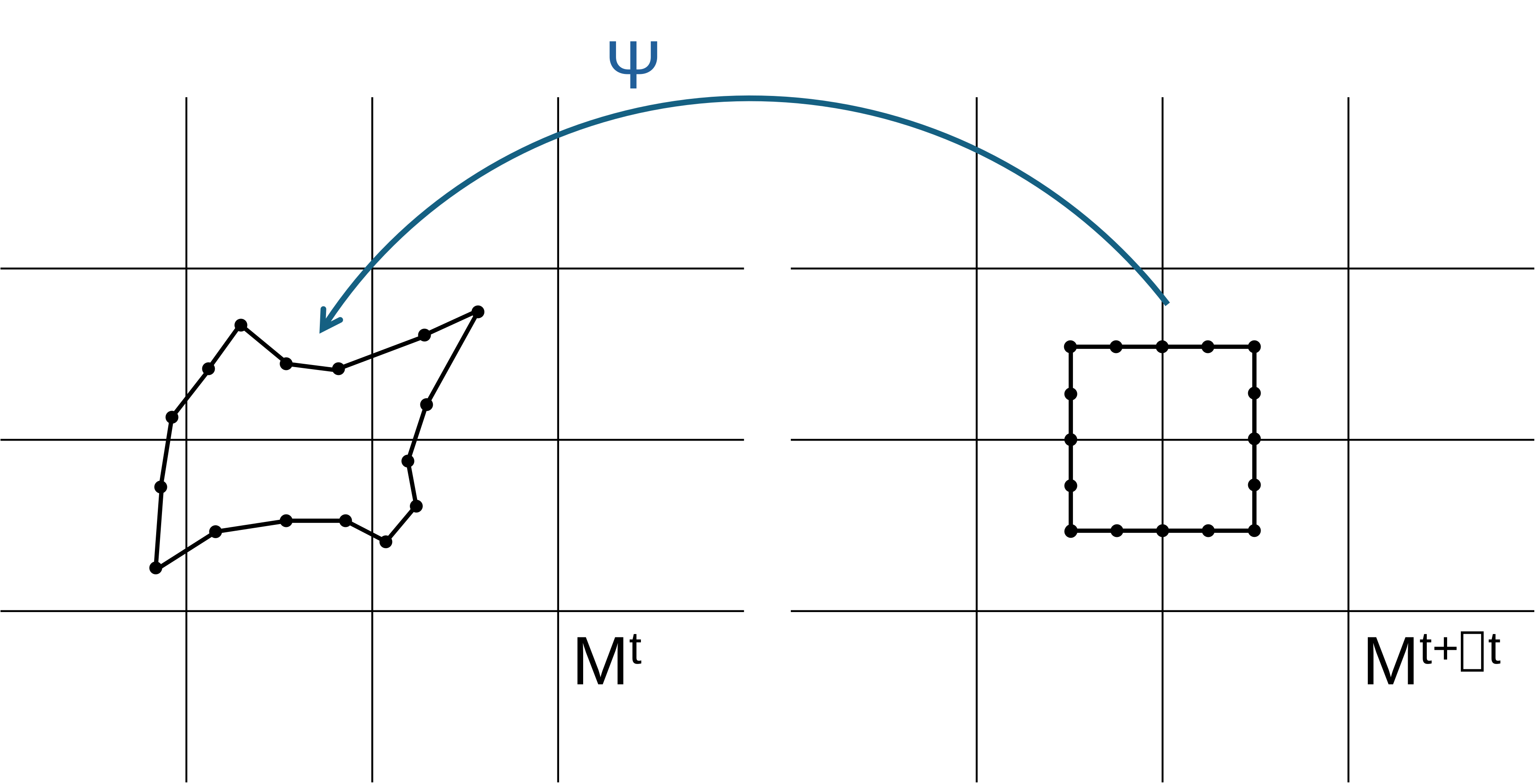
We perform advection by computing line integrals over the backtraced dual grid edges.
Method Overview Diagram
Line integral advection ensures that the circulation along the dual edge loop is equal to the circulation along the backtraced loop. In an incom- pressible 2D fluid, the area enclosed by both loops should also be equal, thus the vorticity (i.e. circulation per unit area) should be conserved.

Qualitative Results

Comparison: Baseline vs Ours
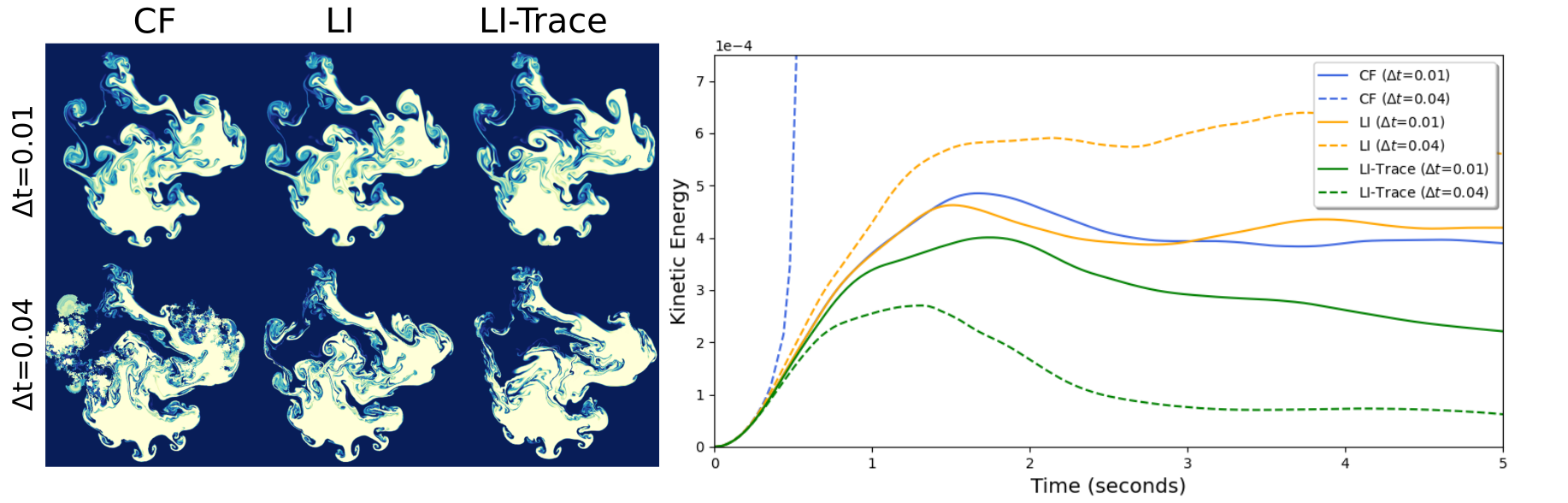
An ink drop in the shape of the SIGGRAPH logo sinks under the influence of gravity. For a time step of Δ𝑡 = 0.01 s, our line integral (LI) method gives similar visual quality as the covector fluids (CF) method of Nabizadeh et al. [2022]. However, at a larger time step of Δ𝑡 = 0.04 s, CF rapidly becomes unstable while LI still gives stable results. Our LI-Trace variant adds a simple heuristic to provide greater stability, in this case eliminating the erroneous increase in energy in the basic LI method.

Comparison between Line Integral Advection and the Covector Advection for simulation of inviscid fluids.